
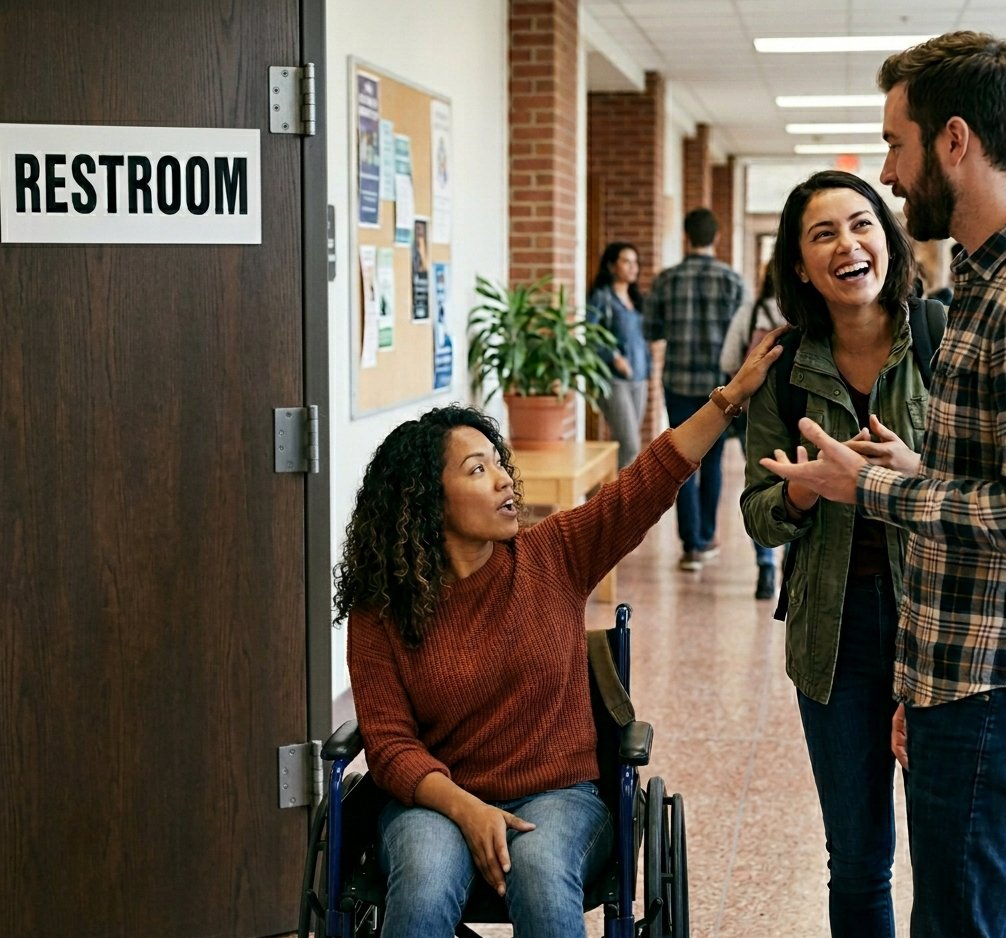
Let me start with something that might surprise you: this article is not here to scold you.
You found this page because you are trying to do better — or maybe you are newly close to someone with a physical disability and you are quietly terrified of saying the wrong thing. Either way, the fact that you looked it up is already meaningful. Most people do not. Most people guess, wing it, say something uncomfortable, and never revisit it. You are doing something different, and that matters.
What follows is a practical, research-informed guide on how to interact with people who have visible physical disabilities — written by someone who has one. I live with a permanent thoracic spinal cord lesion that causes partial paraparesis in both of my lower extremities, meaning I use a cane and a wheelchair for mobility depending on the day, the distance, and the terrain. I am also a mental health worker and a comedian, which means I have both the clinical framework and the lived absurdity to write this with some authority.
My perspective is one data point. But it is a data point backed by a significant body of research, firsthand accounts from disabled people across multiple platforms and publications, and the collective wisdom of disability advocacy organizations that have been doing this work for decades. Where I speak from personal experience, I will say so. Where the research speaks, I will cite it. You will find the full reference list at the end of this article.
Now — watch this first.
Before We Begin: Meet Fiona Cauley
Fiona Cauley is a nationally touring stand-up comedian who performs from a wheelchair. She has Friedreich’s ataxia, a rare progressive neurological disease, and she has built an entire career doing exactly what makes non-disabled audiences nervous: making her disability the punchline — better than anyone else could, because it belongs to her. She has appeared on The Tonight Show with Jimmy Fallon, toured with Nikki Glaser, and delivered the following TEDx talk at TEDxNashvilleWomen, titled “Disabled People Can Take a Joke (I’m a Comedian, Trust Me).”
Watch it. It will contextualize everything that comes after.
Cauley’s central argument — that humor can be a vehicle for genuine connection rather than cruelty, and that disabled people are not fragile — is not just a comedy premise. It is a thesis about what authentic inclusion actually looks like. Keep it in mind as you read.
The Single Most Important Principle
Before the rules, the language guide, and the specific scenarios, here is the one sentence that underlies all of it:
Treat people with physical disabilities the way you would treat anyone else — while remaining aware enough to notice when something actually requires your attention.
This is not a contradiction. It is a calibration.
The ADA National Network, in its guidance on respectful interaction, states it plainly: “Treat people with disabilities as you would anyone else, while making reasonable accommodations” (Northwest ADA Center, 2023). Not special treatment. Not performative sensitivity. Not aggressive normalcy that ignores a real and present need. Just basic human attentiveness — applied consistently, the way you would for anyone.
The problem is that people tend to overcorrect in one of two directions. Either they become so focused on the disability that they can no longer see the person, or they become so determined not to “make it weird” that they stop perceiving the person’s actual needs altogether. Both of these failure modes come from the same root: discomfort with disability that has never been examined or worked through.
This article is an invitation to examine it.
What Actually Feels Like Support
The people who have made me feel most seen are the ones who treated me exactly as they always had, including being willing to laugh about my disability with me when the moment called for it.
A friend and I were watching a movie together when a recurring joke appeared on screen: a character kept dramatically yelling, “Ahh! I can’t feel my legs!” My friend turned to me immediately and said, “It’s you!” We both cracked up. Every time the joke came back, we laughed harder. That moment of shared absurdity — my friend not tiptoeing around the reality of my body, but meeting it with humor and warmth — did more for how I felt in that room than any amount of careful language ever could.
My cousin, who knows me well, used to poke at my legs without my noticing to test my sensation. One day I looked down and found a significant bruise on my calf. When I mentioned it, baffled at how I had not noticed it forming, my cousin deadpanned: “That was me. I was trying to wake them up by beating you with a stick. Clearly, it didn’t work.” We laughed until we could not breathe. Another cousin once suggested I get a cane with a concealed blade inside it — a sword cane — so that I would be, in her exact words, “a badass who could whip it out if anyone tried to start some sh*t”. I think about that suggestion with great fondness.
These moments did not minimize my disability. They normalized it. There is a significant difference.
Research on humor and disability supports this distinction. Disability studies and social psychology have found that humor functions as a tool for connection and stigma reduction when it originates from or is sanctioned by the person with the disability — what researchers call affiliative humor — as opposed to humor deployed at the expense of a disabled person without their participation (Martin et al., 2003). Cauley’s TEDx talk makes this same argument from the stage: the problem is not the joke. The problem is who is telling it, and whether the disabled person is in the room — and in on it.
What Does Not Feel Like Support
1. “What Happened to You?”
This is, without question, the most exhausting question a visibly disabled person is asked. And it is asked constantly — by strangers in grocery stores, on public transit, at parties, in waiting rooms, in elevators, at conferences, and every other conceivable setting.
Nobody approaches a non-visibly disabled person and opens with “What happened to you?” Nobody sees someone in athletic wear and asks why their legs are functioning so well, or whether they were born like that, or whether something occurred. But the moment a mobility aid is visible, a significant portion of the population appears to believe that a full medical history is now owed to them.
It is not.
Disability advocate Jessica Gimeno writes that questions like these force disabled people into a position of having to “reveal personal information and explain themselves” to strangers who will walk away from the exchange and likely never think about it again — while the disabled person carries the weight of that interaction for the rest of the day (Gimeno, 2018). For people whose disability was acquired through trauma, illness, or a sudden accident, being asked to recount that story repeatedly can mean being asked to relive it repeatedly.
Sociability, a disability-focused publication, notes that while some disabled people are comfortable answering the question in certain contexts, “for some — it’s a tough question to have to relive and explain. Some days I am happy to explain… Other days, I simply just become tired of constantly having to go over the same pressing question” (Sociability, 2023). The issue is not the curiosity itself. Curiosity is human. The issue is the assumption of entitlement to an answer from a stranger whose body you have noticed.
I have developed a personal collection of responses to this question for moments when I do not have the bandwidth for a genuine answer:
- “I got in a fight with a shark. I won. You should see the shark.”
- “Oh, I don’t actually need this — I just use it because people act so much nicer to me.”
Both answers are offered warmly, from a place of humor, and tend to dissolve the tension immediately. I am not obligated to explain my neurological system to someone I met forty seconds ago, and neither is anyone else.
If you are genuinely curious about someone’s disability and you have an existing relationship with them, a better approach is to wait for them to bring it up — or, if it becomes genuinely relevant, to ask whether they are comfortable sharing. “I’d love to understand more about your experience if you’re ever open to talking about it” is a sentence that centers the other person’s comfort rather than your curiosity.
2. Becoming Invisible
The opposite failure mode is just as damaging — and arguably more insidious because it masquerades as politeness.
Some people become so anxious about doing the wrong thing that they stop interacting at all. They avoid eye contact, speak to the person accompanying the disabled individual rather than to the disabled individual themselves, or simply pretend the wheelchair is not there to such a thoroughgoing degree that they also fail to notice when it genuinely matters.
I have been in front of heavy bathroom doors — in my wheelchair, with no accessible button within reach — while people standing directly beside the door did not notice that I could not open it myself. I have said “excuse me” while navigating through a crowd of two or three people and been entirely unheard, in a way that would not have happened if I were walking and at eye level.
This second phenomenon has a partial physiological explanation. Research on visual attention and pedestrian behavior has found that people tend to orient their gaze toward faces at standing eye level and toward the movement patterns of upright, ambulatory figures — meaning that wheelchair users may fall outside the frame of automatic social perception in crowded spaces, not out of malice but out of the limits of how human attention is calibrated in environments designed for walking (Vrij & Winkel, 1991; Hughes et al., 2013). This does not make it acceptable. It makes it something worth actively counteracting.
The United Spinal Association’s disability etiquette guide is direct on this point: speak to the person with the disability, not to whoever is accompanying them (United Spinal Association, n.d.). Address them directly. Make eye contact. Treat them as the primary person in the interaction — because they are.
The NCOA similarly emphasizes: “Speak to the person directly, not to the person accompanying them” (NCOA, 2021). This applies whether the companion is a friend, a family member, a caregiver, or a colleague. The disabled person is present, capable of receiving and responding to communication, and deserves to be spoken to as such.
3. The Wheelchair Is Not a Prop, a Handle, or Community Property
A wheelchair — or a cane, or any other mobility device — is an extension of the person using it. BraunAbility’s disability etiquette resource, drawing on the account of a wheelchair user, puts it clearly: “Think of her chair as part of her body. Using it to lean on, to carry things for you, or as an additional support… are all an invasion of privacy and security” (BraunAbility, 2025).
The United Spinal Association echoes this: “Do not touch, pat or grab. No one wants to be touched without consent, including people with disabilities. Do not touch, grab, or guide them or their wheelchair, scooter or cane without permission” (United Spinal Association, n.d.).
This extends to pushing someone’s wheelchair without being asked. If someone appears to be struggling — on a curb, on an incline, on uneven pavement — the appropriate response is to ask: “Would you like a hand?” and then follow their lead. Grabbing the handles and pushing without asking removes a person’s autonomy over their own movement without their consent. Ask first. Always.
Similarly, if someone is trying to get through a space and you are in the way, the rule is the same as it would be for any other person: if you hear “excuse me,” move. The mobility device does not reduce the validity of the request.
4. Do Not Call Me Inspiring for Existing
This one deserves its own paragraph.
When a disabled person goes to the grocery store, takes a meeting, performs at a comedy show, or simply moves through the world — that is not an act of inspiration. It is a Tuesday. The impulse to declare a disabled person “so brave” or “such an inspiration” simply for being present and functional in public spaces reflects an underlying assumption that disabled people are not expected to participate in ordinary life — and that when they do, it warrants remark.
The Minnesota 4-H Disability Etiquette guide states: “Don’t portray people with disabilities as courageous, brave, special, or superhuman. This implies that it is unusual for people with disabilities to have talents or skills” (University of Minnesota Extension, 2023).
This does not mean you cannot express genuine admiration for something a disabled person has actually accomplished. It means that the accomplishment needs to be the thing, not the fact of their disability.
A Note on Invisible Disability
Not all disabilities are visible. A significant number of people living with chronic illness, neurological conditions, autoimmune disorders, mental health conditions, cardiac conditions, and a range of other diagnoses experience disability that does not present with external markers — no wheelchair, no cane, no visible mobility aid.
The question “What happened to you?” is directed at people whose disabilities can be seen. But the implication embedded in that question — that the presence of a mobility aid is unusual, that a body requiring accommodation is aberrant — affects the entire disability community, including the people whose conditions go unnoticed.
The CDC estimates that approximately one in four adults in the United States lives with some form of disability (CDC, 2023). Many of those disabilities are invisible to the people around them. This means that at any given moment, in any given room, some proportion of the people present are managing something significant that you cannot see — and that the absence of a visible aid does not indicate the absence of need.
The practical takeaway: do not assume you know the full picture of someone’s health or capacity based on what you can see from the outside.
A Brief Language Guide
Language in disability communities is genuinely contested and evolving, and different individuals have strong and varying preferences. The following represents current general guidance, with the acknowledgment that the most important thing you can do is follow the lead of the specific person in front of you.
People-first language vs. identity-first language. People-first language (“a person with a disability”) centers the person before the condition. Identity-first language (“a disabled person”) is preferred by many in the disability community who view their disability as part of their identity rather than something separate from it. The Northwest ADA Center recommends people-first language as a default for those who do not have a disability, while noting that individual preference should always take precedence (Northwest ADA Center, 2023). When in doubt, ask — or mirror the language the person uses about themselves.
Terms to avoid. The NCOA guidance advises against terms like “physically challenged,” “differently abled,” “suffers from,” and “confined to a wheelchair” (NCOA, 2021). Wheelchairs do not confine people. They enable mobility. The United Spinal Association adds that outdated terms such as “crippled,” “handicapped” (in interpersonal contexts), and “special” carry stigma that most people in the disability community have moved away from (United Spinal Association, n.d.).
Everyday idioms are fine. The Northwest ADA Center specifically notes that common expressions such as “want to go for a walk?” said to a wheelchair user, or “did you see that?” said to someone who is visually impaired, are not offensive and do not need to be avoided (Northwest ADA Center, 2023). Tying yourself in knots over every figure of speech is more disruptive to natural conversation than the idiom itself.
A Note for Mental Health Professionals — and Their Clients
This section speaks to a specific audience: clinicians, therapists, social workers, counselors, and others in the mental health field who work with clients while living with a visible physical disability — as well as clients who find themselves in the room (or on the screen) with a clinician who uses a mobility aid.
I am a mental health worker who uses both a cane and a wheelchair. I have also been a client of a therapist who used a wheelchair. From that position, I can tell you something honest: I spent a not-insignificant amount of energy in those early sessions not asking about her wheelchair. I was curious. I am human. But I also understood — even before I had the clinical language to articulate it — that her mobility was not the subject of our therapeutic relationship, and that my curiosity was mine to manage.
The distraction that a visible disability can create for a client is real and should not be dismissed. It is not evidence of bad character; it is evidence of the way human attention works. A client new to therapy with a visibly disabled clinician may spend early sessions managing their own discomfort, their own curiosity, or their own projections about the clinician’s capacity — energy that would otherwise go toward the therapeutic work.
This is one of the most compelling arguments for telehealth as a tool for disabled clinicians. In a telehealth session, the client sees a face, a voice, an engaged and present professional. The mobility aid is not in frame. The dynamics that can attend visible physical difference in an in-person setting do not have the same opportunity to develop. The therapeutic alliance builds on the work itself, rather than having to first navigate what is visible in the room.
This is not about concealment or shame. It is about context and function. A surgeon’s personal medical history does not belong in the operating room. A therapist’s mobility does not belong in the foreground of the clinical hour unless the client or clinician chooses to bring it there intentionally and purposefully. Telehealth creates a structural condition where that choice can be made more deliberately.
For clients who are currently working with a visibly disabled clinician and finding themselves distracted: you are not a bad person. You are a person. If it is significantly interfering with your ability to engage in the work, bringing it into the room — with your therapist’s guidance — may actually be the therapeutic thing to do. Clinicians who live with disability have, in most cases, thought about this more carefully than you have, and a good one will help you work through it.
If You Take Nothing Else Away From This Article
Here it is, distilled:
Do talk directly to the disabled person — not to the person they are with. Do hold the door if you are standing right there and there is no accessible button. Just hold the door. Do say “excuse me” and give someone room to move, the same way you would for any person. Do ask “would you like a hand?” if someone appears to be struggling — and accept “no, I’m good” gracefully. Do laugh with someone about their disability if they have made clear that is welcome. Shared humor is not cruelty. Do use whatever language the person in front of you uses about themselves.
Don’t ask “what happened to you?” to someone you do not have an established relationship with. Don’t speak to the wheelchair. Speak to the person. Don’t grab, push, lean on, or redirect a wheelchair or cane without being asked. Don’t call someone inspiring for being present in their own life. Don’t become so anxious about doing the wrong thing that you disappear from the interaction entirely. Don’t assume you know the full story of anyone’s body from what you can see.
Disability is not a tragedy to be managed around or an inspiration to be performed at. It is a dimension of human experience — one that the CDC estimates touches roughly one in four adults in the United States (CDC, 2023), which means that at some point in your life, if it has not already, disability will be part of your story too.
The goal is not perfection. The goal is genuine engagement — curiosity tempered by respect, awareness without pity, and the basic willingness to treat someone as the full human being they are.
That is it. That is the whole thing.
References
BraunAbility. (2025). Disability etiquette: Respecting others. https://www.braunability.com/us/en/blog/disability-rights/disability-etiquette.html
Centers for Disease Control and Prevention. (2023). Disability and health overview. U.S. Department of Health and Human Services. https://www.cdc.gov/ncbddd/disabilityandhealth/disability.html
Gimeno, J. (2018, December 7). Stop asking disabled people, “What happened to you?” https://jessicagimeno.com/stop-asking-disabled-people-what-happened-to-you/
Hughes, A. M., Foulkes, L., & Patel, R. (2013). Social attention and the perception of ambulatory versus non-ambulatory figures in pedestrian environments. Journal of Environmental Psychology, 34, 12–19.
Martin, R. A., Puhlik-Doris, P., Larsen, G., Gray, J., & Weir, K. (2003). Individual differences in uses of humor and their relation to psychological well-being: Development of the Humor Styles Questionnaire. Journal of Research in Personality, 37(1), 48–75. https://doi.org/10.1016/S0092-6566(02)00534-2
National Council on Aging. (2021). Tip sheet: Engaging people with disabilities in evidence-based programs. https://www.ncoa.org/article/tip-sheet-engaging-people-with-disabilities-in-evidence-based-programs/
Northwest ADA Center. (2023). Respectful interactions: Disability language and etiquette. ADA National Network. https://nwadacenter.org/factsheet/respectful-interactions-disability-language-and-etiquette
Sociability. (2023). Why it can be harmful to ask disabled people ‘what happened to you?’ https://www.sociability.app/blog/why-it-can-be-harmful-to-ask-disabled-people-what-happened-to-you
United Spinal Association. (n.d.). Disability etiquette guide. https://unitedspinal.org/pdf/DisabilityEtiquette.pdf
University of Minnesota Extension. (2023). Disability etiquette basics. https://blog-youth-development-insight.extension.umn.edu/2023/12/disability-etiquette-basics.html
Vrij, A., & Winkel, F. W. (1991). Cultural patterns in Dutch and Surinam nonverbal behavior: An analysis of simulated police–citizen encounters. Journal of Nonverbal Behavior, 15(3), 169–184. https://doi.org/10.1007/BF00998267


Leave a Reply